Graphic recording is a powerful way to capture ideas, conversations, and key themes in real time. Instead of relying only on written notes, meeting minutes, or slide decks, graphic recording per event turns spoken information into a visual map that people can understand, remember, and share. It is often used during conferences, workshops, strategy sessions, trainings, community meetings, and corporate events where clear communication matters.
At its core, graphic recording is the live visual capture of ideas. A graphic recorder listens to a conversation as it happens and translates the most important points into words, images, icons, diagrams, and visual structure. The result is a large-scale visual summary that reflects the energy, themes, and takeaways of the discussion. This makes complex information easier to follow and gives participants something meaningful to look back on after the event ends.
For businesses, organizations, and event hosts, graphic recording can help a message stand out. People are often more engaged when they can see ideas taking shape in front of them. Visual storytelling adds movement and clarity to conversations that may otherwise feel abstract or difficult to organize. Whether the goal is to explain a strategy, document group input, or make an event more memorable, graphic recording gives ideas a visual form that supports better understanding.
Graphic recording works because people process visuals quickly. A page full of notes may hold useful information, but it can be hard to scan, remember, or share. A visual record organizes information in a way that feels more natural to the brain. Key points, relationships, priorities, and patterns can be shown through layout, color, symbols, arrows, and simple illustrations.
This is especially helpful during meetings or events with a lot of moving parts. A speaker may cover several topics. A group discussion may move in different directions. A strategy session may include goals, challenges, next steps, and questions. Graphic recording helps bring those pieces together so participants can see the bigger picture.
It also helps people stay engaged. When attendees watch their ideas appear visually, they often feel more connected to the conversation. They can see that their contributions are being heard and included. This can encourage participation and make the experience feel more collaborative.
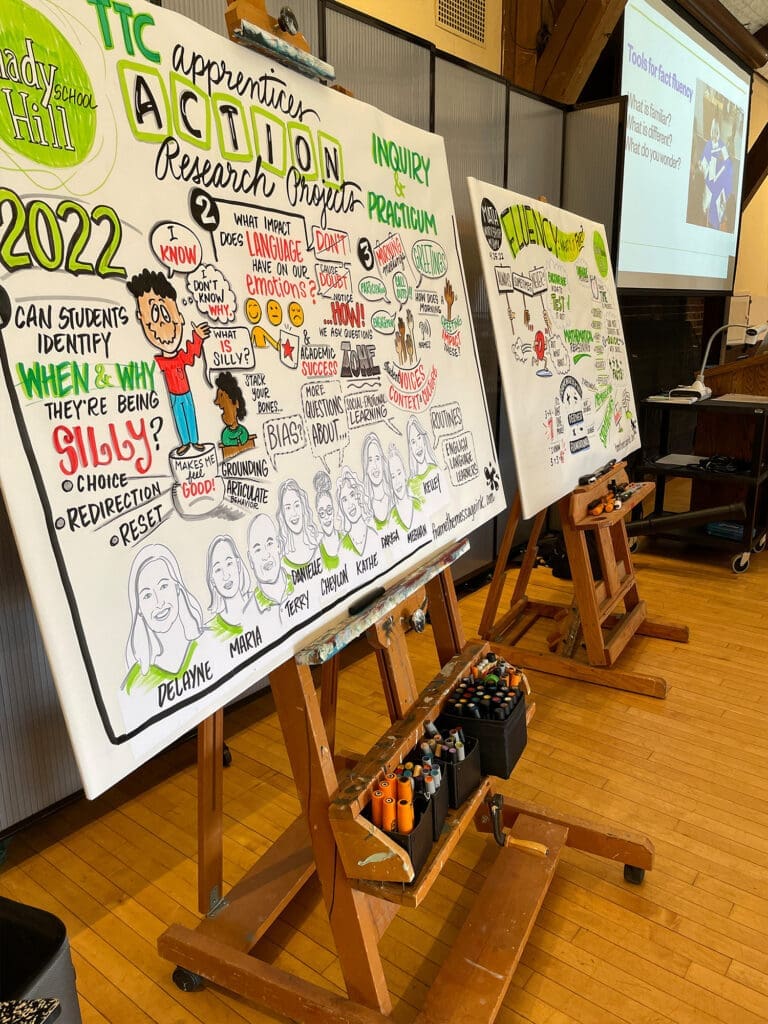
The final visual also becomes a useful takeaway. After the meeting, it can be photographed, digitized, shared with attendees, included in reports, or used as a reference for future planning. Instead of losing momentum after an event, teams can use the graphic recording to continue the conversation.
Events and conferences often include important ideas that can be difficult to capture through traditional notes alone. Speakers may share insights, panels may offer different perspectives, and attendees may discuss challenges during breakout sessions. Graphic recording helps preserve those ideas in a format that is easy to revisit.
At an event, a graphic recorder can work live in front of the audience or capture ideas digitally. As the session unfolds, the recorder listens for themes, quotes, insights, and connections. These are then arranged into a visual story that reflects the flow of the conversation.
This adds value for both attendees and event organizers. Attendees receive a memorable summary of what they learned. Organizers receive a visual asset that can be used after the event for follow-up communication, social media, newsletters, internal reports, or future promotional material.
Graphic recording can also make an event feel more dynamic. It gives people something to gather around, discuss, and photograph. This can increase engagement and create a stronger sense of participation. When people see the event’s ideas come to life visually, the content often feels more meaningful.
Graphic recording is especially useful for business strategy sessions because strategy often involves complex conversations. Teams may need to discuss priorities, market challenges, customer needs, goals, risks, and next steps. Without a clear record, those conversations can become difficult to organize.
A graphic recorder helps turn strategy into a visual framework. They can capture major themes, show connections between ideas, and highlight the decisions that matter most. This can help teams see where they agree, where questions remain, and what needs to happen next.
Visual documentation also helps keep teams aligned after the session. A written report may be helpful, but a visual summary can make the strategy easier to remember. Teams can refer back to the graphic when planning projects, making decisions, or communicating the strategy to others.
For leadership teams, graphic recording can make abstract goals feel more concrete. Instead of leaving a meeting with scattered notes, participants leave with a visual representation of the conversation. That makes it easier to move from discussion to action.
Workshops and training sessions often depend on engagement. Participants need to absorb new information, ask questions, and connect what they learn to their own work. Graphic recording can support that process by making the content easier to follow.
During a workshop, a graphic recorder can capture key lessons, participant responses, group exercises, and important takeaways. This creates a shared visual record of the learning experience. Participants can see how ideas build on each other and how their own contributions fit into the larger topic.
This is useful for training because people learn in different ways. Some participants remember spoken information best, while others understand more when they see a concept visually. Graphic recording supports visual learners and helps reinforce the main points for everyone.
After the workshop, the visual record can be shared as a recap. This gives participants a practical reminder of what they learned and helps them apply the information later. It also gives trainers and facilitators a valuable tool for follow-up.
Graphic recording can also support brand communication by helping organizations explain who they are, what they do, and why their message matters. Many brands struggle to communicate complex services or internal ideas in a simple way. Graphic recording per event can help turn those messages into visuals that are easier for audiences to understand.
This can be helpful during brand workshops, client presentations, planning retreats, and internal alignment meetings. A graphic recorder can capture the language, values, goals, and themes that define the brand. Those visuals can then serve as a foundation for future messaging, marketing, or team communication.
Visual storytelling also helps create a more memorable experience. When people see a message illustrated, they are more likely to remember it. This is why graphic recording can be so valuable for organizations that want to make their ideas stick.
Unlike a standard presentation slide, a graphic recording feels alive and connected to the conversation. It reflects the real discussion, not just a polished script. That makes it more authentic and often more engaging.
A skilled graphic recorder does more than draw. They listen carefully, organize information quickly, and identify the ideas that matter most. They know how to simplify complex conversations without losing meaning. They also know how to create visuals that are clear, balanced, and useful after the session ends.
This combination of listening, design, and storytelling is what makes graphic recording valuable. The recorder is not simply decorating a meeting. They are helping people understand and remember the conversation.
A strong graphic recorder can adapt to different types of events and audiences. They can support corporate meetings, nonprofit gatherings, educational workshops, leadership retreats, creative sessions, and public discussions. Their role is to help the group see what is being said and make sense of the information together.
Graphic recording gives ideas a visual life. It helps people follow conversations, engage more deeply, and leave with a clear understanding of what mattered most. For businesses, organizations, and event hosts, it can turn a meeting or presentation into a more memorable and useful experience.
Whether you are planning a conference, workshop, strategy session, or team retreat, graphic recording can help your audience connect with the message. It captures the key ideas in real time, creates a shared visual record, and gives your team something valuable to use long after the event is over.
When your ideas need to be seen, understood, and remembered, graphic recording is a smart way to bring them to life.
Most meetings ask people to listen, absorb information, and remember the most important parts long after the event is over. The problem is that spoken content alone often fades quickly, especially when the ideas are complex, technical, or packed into a short amount of time. We use visual storytelling to help organizations turn those moments into something people can actually follow, connect with, and remember. When a message becomes visible in real time or through a commissioned visual, it stops feeling temporary and starts feeling usable.
Visual storytelling works because people process images differently than they process spoken or text-heavy information. A visual can show relationships, priorities, and patterns at a glance in a way that long explanations often cannot. That matters in meetings and workshops, where people are trying to take in ideas while also deciding what those ideas mean for their work. When information is made visible, people usually spend less energy trying to decode it and more energy engaging with it.
Retention improves when people have more than one way to understand the message. If an audience only hears a series of talking points, they have to work much harder to organize those ideas in their minds. When those same points are paired with icons, phrases, connections, and visual hierarchy, the message becomes easier to recall later. That is one reason visual storytelling is so valuable in learning environments, strategic planning sessions, and presentations where understanding needs to last beyond the room. People remember what they can see much more easily than what they are asked to hold onto through sound alone.
We also see retention improve because visuals create a shared reference point. Instead of leaving each person to interpret the presentation alone, the group can look at the same image and work from a common understanding. That helps reduce confusion and gives people something tangible to revisit after the event ends. A recorded visual can continue working as a handout, discussion guide, or internal communication asset long after the session is over. That kind of afterlife is one of the strongest practical benefits of visual storytelling.
People do not act on information only because it is accurate. They act when the message feels clear, relevant, and meaningful enough to move them. Visual storytelling helps create that bridge because it brings emotion and understanding together instead of treating them as separate parts of communication. A good visual does not just explain what happened in a meeting. It helps people feel the stakes, the momentum, and the shared purpose behind the conversation.
That emotional connection matters in organizations because alignment rarely comes from facts alone. Teams may hear the same strategic plan, keynote, or training session and still walk away with very different interpretations. When the message is captured visually, it becomes easier to see how the pieces connect and why they matter. A visual can highlight tension, possibility, progress, and collective goals without turning the message into something overly complicated. That helps people connect not only with the content, but also with each other.
We find that action becomes more likely when people leave with a message they can actually revisit and talk about. A visual story keeps the conversation alive because it gives teams language, images, and structure they can return to when they make decisions later. It also makes the original presentation feel less like a one-time event and more like the beginning of a larger process. That is especially useful for leaders, trainers, and facilitators who want their sessions to influence behavior after the meeting ends. Visual storytelling supports that kind of lasting impact because it turns insight into something people can carry forward.
One of the most powerful parts of visual storytelling is real time scribing. When ideas are being drawn live as people speak, the room changes almost immediately. Audiences become more attentive because they can see the conversation take shape in front of them. Presenters become easier to follow because their ideas are no longer moving past people in sound alone. What might have felt like a standard presentation starts to feel more like a live conversation with visible momentum.
Real time capture also creates a stronger sense of participation. People can see their ideas reflected, connected, and elevated as the visual develops. That makes workshops and meetings feel more collaborative because contributions do not disappear the moment someone stops talking. Instead, they become part of a larger visual map that everyone can see and respond to. This is one of the reasons visual storytelling works so well in strategic planning sessions, keynotes, community engagement forums, and collaborative workshops.
We believe this live element is what helps many organizations move from passive attendance to active engagement. A scribed visual creates energy in the room because people can literally watch meaning being built in real time. That creates curiosity, sharpens focus, and helps participants stay connected to the bigger picture as the discussion evolves. It also gives facilitators and presenters a better chance of holding attention without relying on slide-heavy delivery. When people can see their thinking unfold, the meeting feels less static and more alive.
Visual metaphors are one of the most practical tools in visual storytelling because they help people understand abstract ideas quickly. Many presentations deal with concepts like growth, alignment, innovation, systems thinking, change, or leadership. Those ideas can become vague when they stay trapped in corporate language or text-heavy slides. A well-chosen image gives the audience a way to understand the concept almost instantly. That matters because clarity often begins when people can picture the idea, not just define it.
A metaphor does more than make the message look interesting. It simplifies without flattening the idea into something too basic. A pathway, bridge, ecosystem, thread, or map can help people understand relationships and movement in a way that plain language often struggles to do on its own. That is especially useful in workshops and presentations where the goal is not simply to explain a concept, but to help people use it. Visual storytelling gives those concepts shape, and shape makes the message easier to work with.
Frame The Message Ink is especially well positioned to do that kind of work because the site centers on graphic recording, commissioned visuals, sketch videos, and facilitation support that help ideas become visible and memorable. The business is led by Taryl Hansen, who brings more than 25 years in education and adult professional development to this work, and that background shows in the way the services are framed around learning, engagement, and understanding. We do not see the service as decoration added after the fact. We see it as a communication tool that helps audiences make sense of complex ideas in live, virtual, and commissioned formats. That is a big reason organizations looking for visual storytelling support in Phoenix and beyond would benefit from contacting Frame The Message Ink.
One of the strongest reasons to invest in visual storytelling is that the value does not stop when the meeting ends. A recorded visual can be reused in follow-up communication, training materials, recap documents, internal presentations, and leadership conversations. That means the message has a life beyond the room and can keep helping teams remember what mattered most. Instead of fading into meeting notes that nobody reopens, the content stays visible and usable. That alone makes the original event more valuable.
We also think organizations benefit because visual work supports both clarity and continuity. A single meeting may only last an hour, but the decisions, alignment, and communication that follow can stretch over weeks or months. When the original conversation is captured visually, teams have something concrete to revisit as they keep moving. That helps reduce drift and keeps people connected to the purpose of the work. For leaders, trainers, and presenters, that is often the difference between a session that sounded good in the moment and one that actually changes what happens next.
Visual storytelling helps meetings, workshops, and presentations make a lasting impact because it turns ideas into something people can see, remember, and use. It strengthens retention, creates emotional connection, makes real time conversations more engaging, and uses visual metaphors to simplify what might otherwise feel abstract or forgettable. Frame The Message Ink offers that kind of support through live and virtual graphic recording, commissioned visuals, and sketch videos designed to help organizations communicate with more clarity and staying power. If the goal is to make your next event more memorable and more useful after it ends, we encourage you to contact Frame The Message Ink and start the conversation.
My connection to TEDx started in 2016 when I gave my first TEDx talk, Mastering the HeART of Communication. That experience opened a new door for me as a speaker, a listener, and eventually as a visual scribe who wanted to keep supporting strong ideas after the applause ended. Not long after that, I became part of a student-led TEDx community built around curiosity, leadership, and thoughtful storytelling. Ten years later, I still care deeply about the TED world because I have seen how one event, one speaker, or one image can stay with people long after they leave the room.
When I show up to a TEDx event as a visual scribe, I am not only drawing what I hear. I am listening for the heart of a speaker’s message, the thread that holds the talk together, and the moments that will stick with an audience after the event is over. I pay attention to key phrases, emotional turns, strong metaphors, and the structure of the story. Then I turn those ideas into visuals that help people remember what mattered.
That process looks fast from the outside, but it starts long before the marker hits the page. I am constantly sorting information, deciding what supports understanding, and thinking about how to make a complex message feel simple without making it shallow. A visual scribe has to balance speed, clarity, and emotion all at once. That challenge is exactly why I love this work and why TEDx has been such a meaningful place to do it.
For me, live graphic recording is one of the most honest forms of listening. I have to stay fully present, trust my instincts, and respond to ideas as they unfold in real time. That is especially exciting in a TEDx environment because every talk is built around an idea worth spreading, and I get to help that idea take on another form. The visual becomes a second doorway into the speaker’s message, which can be incredibly powerful for the audience.
Frame The Message Ink grew out of my belief that ideas deserve more than one way to be heard. Spoken language can move people in the moment, but visuals help ideas stay visible, easier to revisit, and more likely to travel beyond the room. That is one reason I have stayed involved for so many years. I wanted to keep a good thing going and continue giving back to the TED community in a way that felt true to my work.
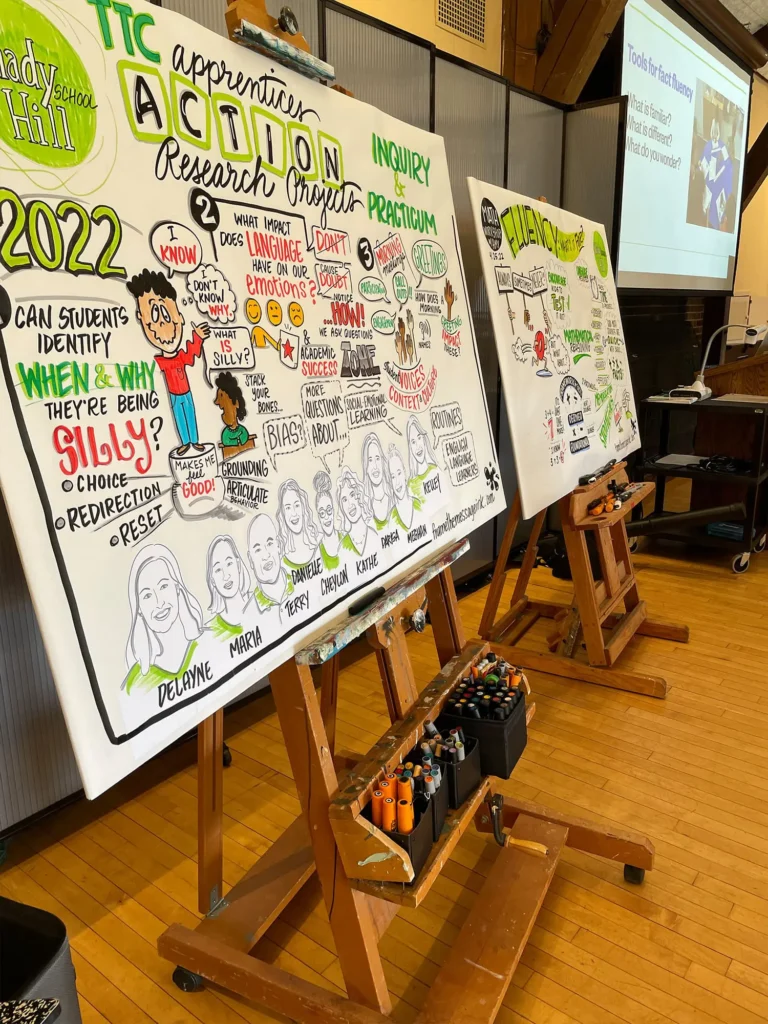
I have drawn live at TEDxTucson and then almost every year for nine years within this student-led TEDx tradition in Phoenix. Over time, I have watched speakers, student organizers, and audience members all bring their own energy to the experience. What I love most is that the visual work does not end when the event ends. It becomes a way to help speakers share their ideas more broadly and help viewers connect with those talks after the stage lights are off.
That bigger purpose is part of how I think about Frame The Message Ink as a business. My work is not about decoration for decoration’s sake. It is about turning ideas into visual stories that support understanding, retention, and engagement in ways people can carry into the future. The site reflects that clearly through live and virtual graphic recording, commissioned illustrations, and sketch videos, all built around helping messages become memorable.
One of the things I hope readers take from this story is that graphic recording is not only for TEDx. If you have ever watched a talk and thought, I wish I could bring that kind of energy and clarity into my own conference, workshop, classroom, board retreat, strategic planning session, or keynote event, you absolutely can. A visual scribe can help people follow complex information more easily and stay connected to the bigger message. That is true in education, nonprofit work, business settings, leadership training, healthcare, community engagement, and so many other spaces.
People are often curious about how this kind of live notetaking works outside a speaker event. The answer is that the purpose stays the same even when the format changes. I listen for key ideas, capture the flow of the conversation, and create a visual that helps participants understand and remember what happened. Whether the setting is a workshop, a multi-day retreat, or a presentation, the visual gives people something they can return to instead of leaving with only scattered notes or fading impressions.
I have found that many leaders and planners do not realize this industry exists until they see it in action. That is why I love sharing the process and opening the door a little wider. Once people understand what a visual scribe does, they often start imagining how it could support their own teams, events, or organizations. That curiosity is exactly what I hope this article sparks, because good ideas are not limited to one stage or one brand.
I also hope this article nudges more people to attend a TEDx event in their own community. Watching TED and TEDx talks online is valuable, but being in the room is a different experience. You feel the attention, the anticipation, the nerves, and the shared energy of people listening together for something that might challenge or inspire them. That sense of community is one of the reasons TEDx continues to matter.
What has always stood out to me about this Phoenix-based student-led TEDx event is how much ownership the students bring to it. It does not feel like a copy of something bigger. It feels like a living event shaped by people who care about ideas, leadership, and doing meaningful work together. That spirit is part of what made this Legacy Year feel important, because it marked ten years of students and supporters building something that keeps evolving.
I would love to see more people attend a TEDx event, whether it is in their hometown or at next spring’s student-led TEDx event in Phoenix in 2027. These events give people a chance to experience ideas in a more human way and see what happens when a community builds something thoughtful together. They also remind us that great talks do not only come from famous names or major stages. Sometimes the most memorable ideas come from local speakers and local rooms full of people who care.
Another big hope I have for this article is simple. I hope people watch more TED and TEDx videos and share them. A talk does not stop working after the event ends, and every additional view helps a speaker’s message move farther than it could have on its own. That matters to me because I know how much time, courage, and heart speakers put into shaping a talk that may only last a few minutes on stage.
I especially hope people seek out and share talks connected to this past legacy year and the speakers who made it meaningful. A talk can keep opening doors long after it is recorded if people are willing to send it to a friend, mention it in a class, use it in a meeting, or post it somewhere others will find it. That is one of the reasons I stay involved. I want to support speakers not only while they are presenting, but also while their ideas continue finding new audiences.
For me, this ten-year reflection is really about staying connected to a community built around thoughtful communication. TEDx gave me a place to speak, listen, draw, and keep learning from other people’s ideas. Frame The Message Ink gave me a way to contribute something real to that experience through visuals that help ideas last longer and travel farther. If this story makes you want to watch a talk, attend a TEDx event, learn more about the history of TEDx, or explore how a visual scribe could support your own work, then it has done exactly what I hoped it would do.