
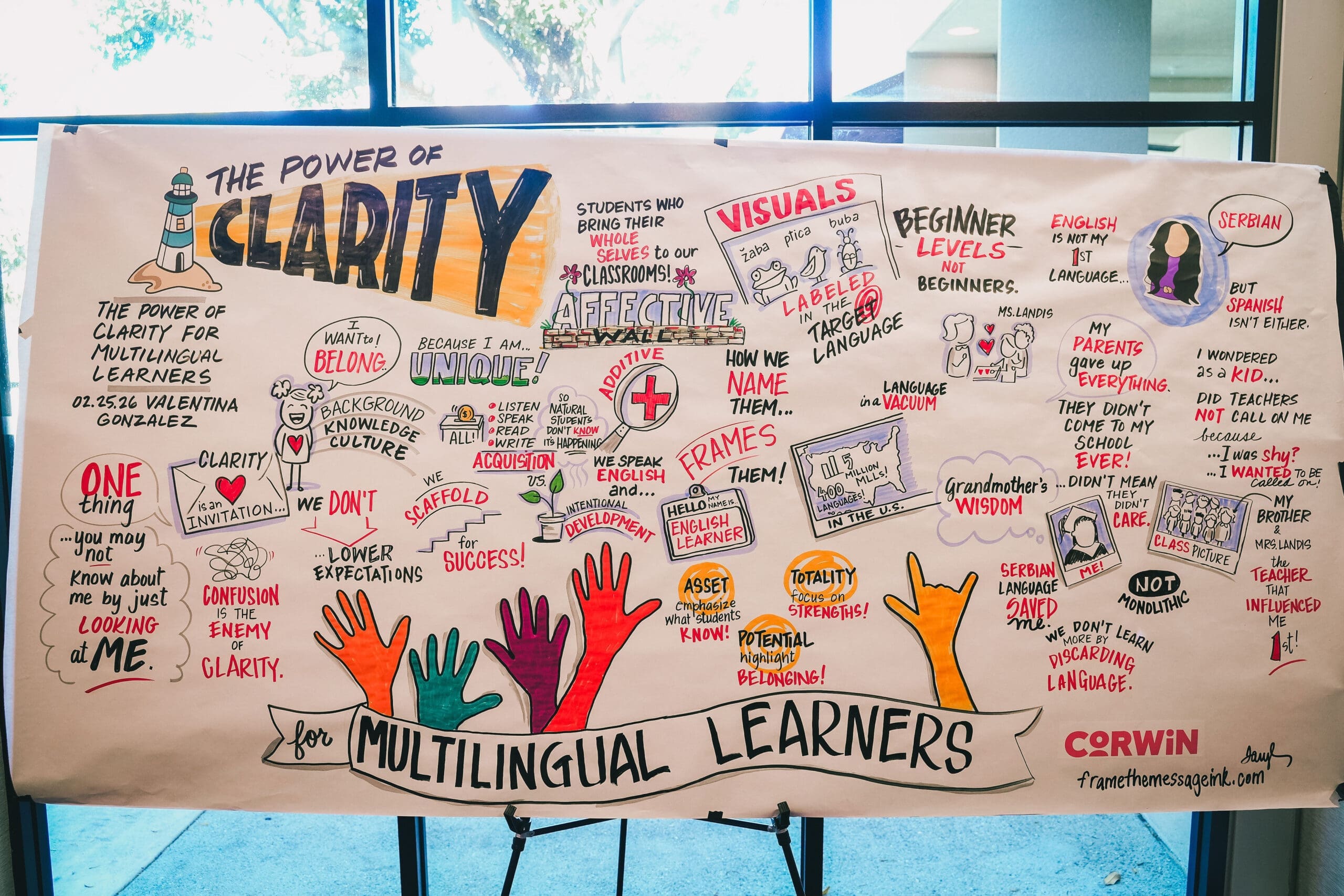
I love the chance to draw alongside educators who want their work with students to feel practical, not abstract, especially when time runs short, and the urgency to meet the needs of students is real
On February 23-25, 2026, over 600 educators gathered for Corwin’s 2026 Annual Teacher Clarity Playbook Conference in San Diego, California. Throughout the conference, I illustrated keynotes for Doug Fisher, Nancy Frey, Valentina Gonzalez, John Almarode, and Dominique Smith, leaders in the field of education.
I decided to draw LIVE at the 2026 Annual Teacher Clarity Playbook Conference because the conference focus deserves a learning format that matches its message. Teacher clarity asks teachers to be clear, so the ideas shared by experts should also feel clear in the moment. Many educators attend conferences to learn more, but multi-day learning can overload working memory and create cognitive fatigue. Even great sessions can blur together when your brain stores too many new concepts without enough structure. Live graphic recording creates that structure as the learning happens, so your brain has anchors to return to later. My goal was for every attendee to leave with ideas they could use on Monday, not just notes they forget on Friday.
Doug Fisher and Nancy Frey’s widely published work on Teacher Clarity sits at the center of strong instruction because students learn more when goals, outcomes, and evidence are clear. Keynote ideas were captured in real time so listeners could see connections across sessions instead of holding everything in separate buckets. In the live illustrations, you will see goals, outcomes, success criteria, and evidence appear visually as speakers build their messages. That clarity supports planning and prediction, which helps teachers set implementation goals and measure progress in their own classrooms. Students learn more when expectations stay clear, and teachers benefit the same way during professional learning and professional development. I wanted the live illustrations to model the same “learning journey” we want students to experience in class.
There is great value in the energy that live drawing brings to adult learning. An active brain stays engaged, and engaged learning supports stronger transfer back to the classroom. Even if you could not attend, here are some key takeaways from the keynotes shared at the event:




I also have a time lapse video!
Adopt Teacher Clarity work in teams across schools and districts
I know the strongest results occur when schools treat Teacher Clarity as a shared practice instead of a solo strategy. Teams move faster when they use common language for learning intentions, success criteria, and evidence of learning. This shared approach can also strengthen visible learning for literacy by helping teachers make goals, expectations, and evidence of student progress easier to understand and apply. The Illustrated Guide to Teacher Clarity helps teams align because visuals reduce interpretation gaps and make discussion more precise. That precision matters during lesson planning, walkthroughs, coaching conversations, and student support meetings. The goal stays simple: everyone understands what students are learning, students know how and why they are learning it, and adults respond in ways that support full clarity through evidence of that learning.

Our newest publication, An Illustrated Guide to Teacher Clarity, was released in January 2026 and went out to conference attendees, who were lucky enough to receive a first glimpse at Corwin’s newest book. This book is an Introduction to the Teacher Clarity work and is intended to be use alongside the many books in the Teacher Clarity series. These include:
Teacher Clarity Playbook: A Hands-On Guide (Editions 1 and 2)
Success Criteria Playbook: A Hands-On Guide
Teacher Clarity: 4 Components for High-Impact Student Learning
Leading Teacher Clarity: A Guide for Implementation Success
Together, we designed An Illustrated Guide to Teacher Clarity to work well for book studies and professional learning communities.
Teams can read a section, look at the visuals, and immediately plan how to apply one move in the next week. Instructional coaches can use the pages to support consistent feedback and to keep coaching tied to shared definitions.
Administrators can use the clarity framework to align professional learning priorities with what teachers actually do in lessons, which is why many educators place it among their most-used education books, teacher resources, and professional development tools for implementation.
District leaders can build coherence by using the same terms across sites and grade levels. When you build a shared instructional language, you reduce confusion and increase follow-through.